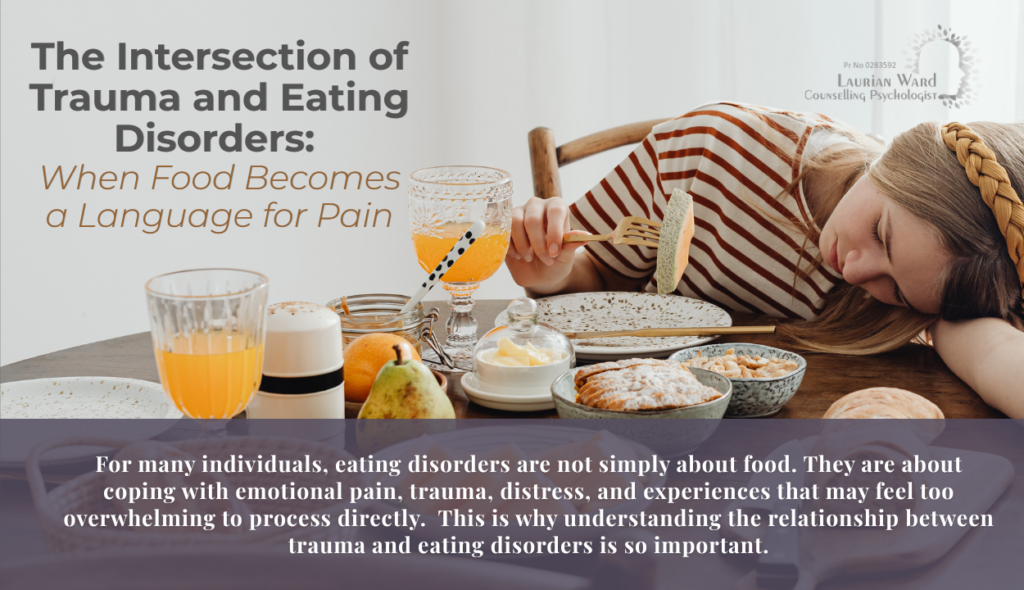
When Food Becomes a Language for Pain
By Laurian Ward Counselling Psychologist
When most people think of eating disorders, they often focus on food, weight, or body image. While these factors can certainly play a role, the reality is often far more complex. For many individuals, eating disorders are not simply about food. They are about coping with emotional pain, trauma, distress, and experiences that may feel too overwhelming to process directly. This is why understanding the relationship between trauma and eating disorders is so important.
When Trauma Finds Another Way to Speak
Trauma affects more than our thoughts and memories. It impacts the nervous system, emotional regulation, self-worth, and our sense of safety in the world.
When people experience trauma – whether through abuse, neglect, bullying, loss, family conflict, medical trauma, or chronic stress – they may struggle to express what they are feeling. Sometimes the emotional pain feels too large, too confusing, or too frightening to put into words.
The body then begins to communicate what the mind cannot.
For some individuals, food becomes a way of managing overwhelming emotions. Restricting food intake may create a temporary sense of control. Binge eating may offer momentary comfort or relief from emotional distress. Purging behaviours may become a way of coping with feelings of shame, anxiety, or self-criticism.
The eating disorder is not the problem itself – it is often an attempt to solve a deeper problem.
Why Trauma and Eating Disorders Often Coexist
Research consistently shows a strong connection between trauma and eating disorders. Many individuals who struggle with anorexia, bulimia, binge eating disorder, or disordered eating patterns have experienced significant emotional distress or adverse life events.
Trauma can leave people feeling powerless, disconnected from their bodies, and unable to trust themselves. Eating disorder behaviours may then develop as a way to regain a sense of control, numb difficult emotions, or create predictability in an otherwise overwhelming world.
While these behaviours may provide temporary relief, they often create additional physical, emotional, and relational difficulties over time.
Looking Beyond the Symptoms
One of the most important aspects of therapy is helping individuals understand that recovery is not simply about changing eating habits.
True healing involves understanding the emotional needs, experiences, and wounds that may exist beneath the eating disorder.
This does not mean blaming parents, families, or specific life events. Rather, it means creating a safe space where individuals can explore their experiences, understand their emotional world, and develop healthier ways of coping.
For adolescents, early intervention is particularly important. Changes in eating habits, significant weight fluctuations, social withdrawal, excessive exercise, body dissatisfaction, anxiety around food, or preoccupation with appearance should never be ignored.
The earlier support is sought, the greater the opportunity for recovery and long-term wellbeing.
Healing Is Possible
Recovery from an eating disorder is not about willpower. It is about understanding what the eating disorder has been trying to communicate and developing healthier ways to meet those underlying needs.
Therapy provides a safe, supportive environment where individuals can begin to make sense of their experiences, reconnect with themselves, and develop a healthier relationship with both food and their emotions.
If you or someone you love is struggling with disordered eating, body image concerns, or emotional difficulties related to food, help is available.
You do not have to navigate this journey alone.
To learn more or to schedule an appointment, contact Laurian Ward Counselling Psychologist. Taking the first step toward support can be the beginning of lasting healing and recovery.