Embracing the Reality of Neurodiversity
We often hear the terms “neurotypical” and “neurodivergent” in modern conversation—but what do they actually mean, and why has this distinction become so important in the field of psychology?
For a long time, the clinical world worked from a single reference point: what was considered “typical” brain development and behavior. This became the benchmark against which attention, communication, emotional regulation, and learning were measured. Anything falling outside this narrow window was often framed through the lens of a “disorder.”
However, research over the past two decades has fundamentally shifted this view. We now understand that there is no single “normal” brain.
Understanding Neurodiversity
The term neurodivergent emerged to describe natural variations in how the brain processes information, experiences the world, and responds to stimuli. This includes profiles such as Autism, ADHD, Dyslexia, and others. The shift in perspective treats these not as deficits to be “fixed,” but as differences to be understood.
This evolution is reflected in our diagnostic frameworks. In the DSM-5, conditions like Autism Spectrum Disorder are no longer viewed in rigid categories, but as part of a broader spectrum—recognizing variability, individuality, and context. The fundamental question has moved from “What is wrong?” to “How does this person experience and engage with the world?”
The Divergent Experience
Current research continues to highlight that neurodivergent individuals often present with distinct internal landscapes, including:
-
Different sensory processing patterns: A heightened or reduced sensitivity to lights, sounds, or textures.
-
Unique cognitive strengths: Exceptional pattern recognition, deep focus, or creative problem-solving.
-
Alternative communication styles: Directness, non-verbal expression, or different ways of processing social cues.
-
Variable environmental responses: Unique ways of regulating emotions or energy levels in response to external input.
Why Language Matters
This is not about labeling people for the sake of categorization. It is about improving understanding.
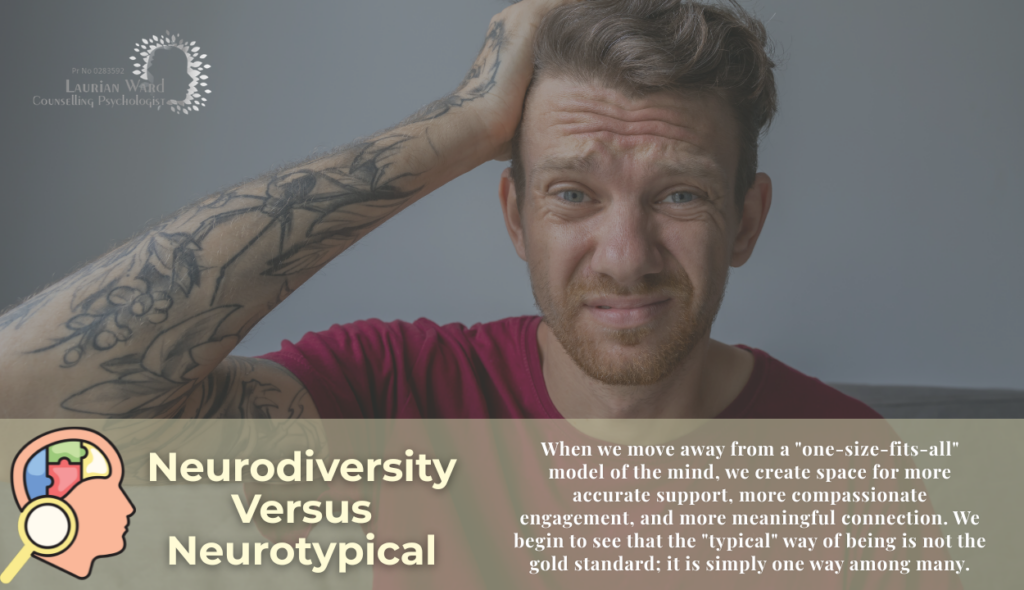
When we move away from a “one-size-fits-all” model of the mind, we create space for more accurate support, more compassionate engagement, and more meaningful connection. We begin to see that the “typical” way of being is not the gold standard; it is simply one way among many.
Recognizing neurodiversity allows us to build environments—at home, at school, and in the workplace—where every kind of mind can thrive.
Laurian Ward Counselling Psychologist