By Laurian Ward – Counselling Psychologist, Pretoria East
In the mental-health world, mindfulness – has become one of the most used—and misused—words in recent years. But beyond the trends, beyond the Instagram quotes and the meditation apps, lies a clinically grounded truth: mindfulness is not optional for therapeutic growth. It is foundational.
What Mindfulness Really Means in Therapy
Mindfulness is the ability to notice your internal world—your thoughts, feelings, impulses, and body states—without being swallowed by them. It is not relaxation. It is not zoning out. It is not positive thinking.
In clinical work, mindfulness is the skill that shifts a client from reactive survival mode to conscious choice.
Without it, therapy becomes an intellectual exercise instead of an emotional transformation.
The Mental Health Industry’s View: Supported by Decades of Research
Mindfulness is not a fringe concept; it is evidence-based.
Research from the last 30 years—including studies by Harvard, Oxford, and major psychiatric institutions—consistently shows that:
-
Mindfulness reduces symptoms of anxiety and depression.
-
It improves emotional regulation and impulse control.
-
It strengthens the prefrontal cortex (your decision-making centre).
-
It lowers stress hormones such as cortisol.
-
It increases resilience in trauma treatment.
Mindfulness -Based Cognitive Therapy (MBCT) is now internationally recognized as effective for preventing depressive relapse. Trauma researchers such as Bessel van der Kolk have emphasized that mindfulness restores the mind-body connection disrupted by trauma.
 **Can a Client Grow Without Mindfulness?
Not sustainably.**
A client who is not mindful struggles to:
-
Identify their patterns
-
Recognize their own avoidance
-
Notice what triggers dysregulation
-
Take responsibility for their reactions
-
Pause before repeating familiar self-destructive cycles
Therapy requires self-observation. Without mindfulness, a person keeps outsourcing blame, outsourcing insight, and outsourcing healing.
You cannot change what you refuse to see.
What Clients Need to Understand
Mindfulness is not a performance.
It is not about being calm all the time.
It is the willingness to say:
“This is what I’m feeling right now, and I will stay present with it long enough to understand it.”
That is where healing begins.
Mindfulness and the Holiday Season
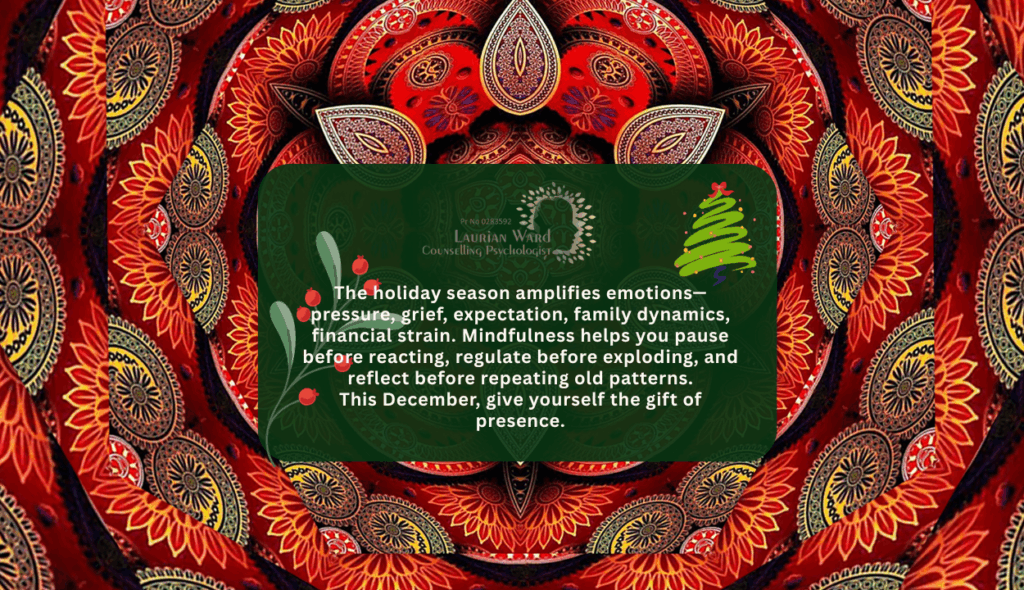
December amplifies everything—stress, expectations, loneliness, overstimulation, and unresolved family wounds. Mindfulness becomes both a shield and a compass:
-
A shield from absorbing everyone’s energy, opinions, and emotional chaos.
-
A compass that keeps you anchored in your values instead of old family roles.
Being mindful this season means slowing down before reacting, choosing presence over performance, and remembering that peace is an internal practice, not an external condition.
The Takeaway
If you want therapy to work, mindfulness is non-negotiable.
And if you want December to be less overwhelming and more meaningful, mindfulness is your starting point.
Awareness is the doorway. Healing is what follows.
Follow Me on Facebook.